An equine vet invoice has to answer four questions for the person who opens it: who is being billed, for which horse, for what, and by when. Small-animal invoice templates assume the first two are the same person and the same pet every time. In equine work they often are not, and most billing queries trace back to an invoice that got one of them wrong.
This is a walk through each part of the invoice, with the decisions an equine practice has to make at each one.
1. Who the invoice is addressed to
The default is the horse's owner. The exceptions are common enough to plan for:
- Several owners. A horse owned by a partnership or syndicate needs one invoice per owner, each for that owner's share. One invoice sent to "the syndicate" tends to be paid late, because nobody owns the whole balance.
- A trainer who covers routine work and passes it on.
- An insurer, with the carrier and policy number on the invoice.
- A buyer paying for a pre-purchase exam on a horse they do not own.
Whoever it is, the invoice should still be filed against the horse. The patient is the constant, and the payer changes.
2. The horse and the service date
Each invoice names the horse and carries the date the service was provided, which is not always the date the invoice was written. For a practice that invoices at the end of a barn day, or the next morning, the difference matters when an owner compares the invoice to their own diary.
3. The farm call
Ambulatory practices charge for getting there, and practices handle it in different ways: a flat call fee, a fee by zone, or mileage. Whichever you use, it should be its own line. A call fee folded into the exam price is invisible to the client and impossible to report on.
When one visit covers several horses at a barn, the call is normally shared between the owners present that day. That split is where hand-built invoices most often go wrong.
4. Line items
Services and dispensed items, each with a description, quantity, unit price and total. Two habits make these lines easier to defend:
- Price from a list, not from memory. If the exam is $85 on Monday and $95 on Thursday, the client notices.
- Separate what was done from what was dispensed. Sedation given during a dental and a tube of paste sent home are different things to the client, and often different things for tax.
5. Tax and your registration line
Sales tax, GST or VAT applies differently to services and products depending on where you practise. That part is your accountant's call. What the invoice needs is the tax shown as its own figure, and your registration number printed where the client's bookkeeper will look for it.
6. Due date and payment terms
Every invoice needs a due date, because "overdue" has no meaning without one. Terms such as "payment due upon receipt" belong in writing on the document. If you charge interest on late accounts, the client should have seen that sentence before the first reminder.
7. How to pay
A card link, a bank reference, or an address for a check. An invoice that makes the client phone the office to find out how to pay is going to wait.
How each part is set in StableTrack
Who it bills. A new invoice has a Bill to field: Owner, Insurance, Trainer or Third party. Insurance pulls the carrier and policy number from the horse's record. Third party takes a one-off name and address. In each case the invoice stays linked to the horse.
Several owners. Ownership percentages are set once on the horse. When a SOAP note is completed or a barn visit is run through Barn Operations, the draft splits into one invoice per owner for their share, and each carries a Split badge. Each split invoice is then independent: one owner disputing a charge does not hold up the others. The equine billing software page covers the barn workflow.
Line items. Services come from Service Pricing in Settings. Inventory items appear on invoices once they are priced, either at a fixed price or cost-plus.
Registration line and terms. Both are under Settings, Invoicing Settings. The tax registration line prints exactly as you type it under your clinic address, so include your own label ("EIN 12-3456789", "VAT No. ..."). The payment terms note prints under the totals on statements.
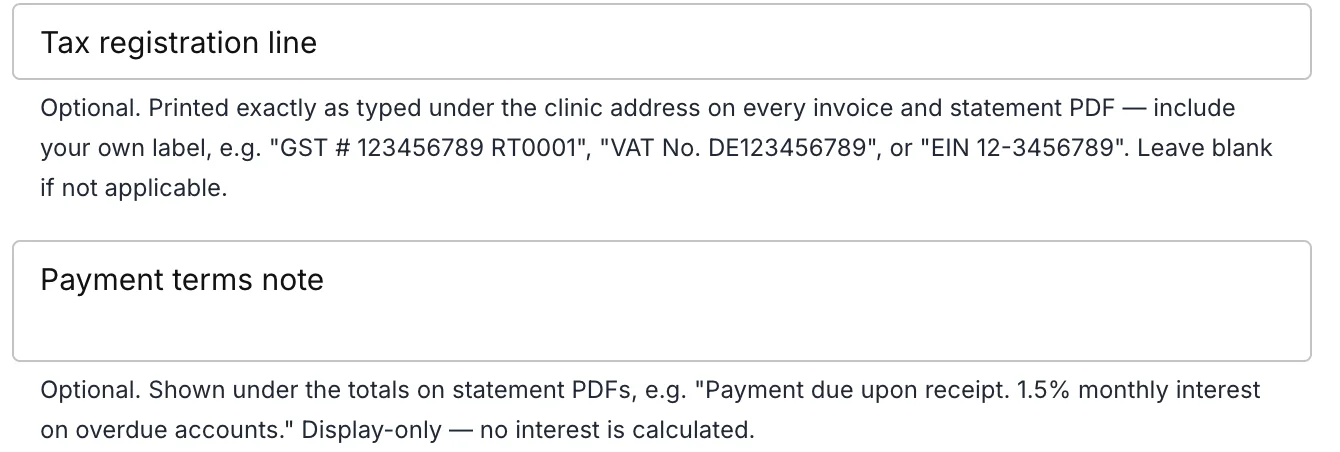
One thing to know: the payment terms note is display only. StableTrack prints what you write but does not calculate interest, add late fees or move a due date. Due dates come from Default Payment Due in Billing Defaults.
Status. An invoice is Pending when saved, Paid when the full balance is recorded, and becomes Overdue automatically when its due date passes unpaid.
Paying. With Stripe connected, card and ACH payments are taken against the invoice. Cash, check and other methods are recorded by hand, and you can add your own payment types.
StableTrack does not decide what is taxable in your state or country. It applies the tax rate you set.
FAQ
What should an equine vet invoice include? The party being billed, the horse, the service date, a separate farm call line, itemised services and dispensed products with prices, tax shown separately with your registration number, a due date, payment terms, and how to pay.
How do you invoice a horse with more than one owner? Send each owner their own invoice for their share. In StableTrack the ownership percentages are stored on the horse, and the invoice splits into one per owner when the visit is completed.
Can a vet invoice be sent to a trainer or an insurer? Yes. In StableTrack the Bill to field on a new invoice switches between Owner, Insurance, Trainer and Third party, and the invoice remains on the horse's record.
Does StableTrack add late fees automatically? No. The payment terms note is printed as written. Interest and late fees are not calculated.
To see an invoice built from one of your own barn days, book a walkthrough.