An equine dental chart is a tooth-by-tooth record of what was found in a horse's mouth and what was done about it. Most charts use the modified Triadan system, which gives every tooth a three-digit number, so "sharp points on 108 and 208" means the same thing to the next person who opens the record. This post covers how the numbering works, what a chart should hold besides the float, and where charts usually fall short a year later.
How the Triadan system numbers a horse's teeth
Each number has two parts. The first digit is the quadrant. The last two digits are the tooth's position, counted from the midline of the mouth toward the back.
| First digit | Quadrant (permanent teeth) |
|---|---|
| 1 | Upper right |
| 2 | Upper left |
| 3 | Lower left |
| 4 | Lower right |
The quadrants run clockwise as you face the horse, starting at its upper right. Deciduous teeth use 5 to 8 in the same order, so 501 is the upper right deciduous central incisor.
| Position | Tooth |
|---|---|
| 01, 02, 03 | Central, intermediate and corner incisors |
| 04 | Canine |
| 05 | First premolar, the wolf tooth |
| 06, 07, 08 | Second, third and fourth premolars |
| 09, 10, 11 | First, second and third molars |
So 106 is the first cheek tooth on the upper right, and 311 is the last molar on the lower left. The numbers are reserved even when the tooth is absent. A mare with no canines still has no 104, and the first cheek tooth is still 06. That is the point of the system: the number describes the position, so a missing wolf tooth never shifts everything behind it.
What belongs on the chart
A chart that only says "floated, routine" is hard to use at the next visit. The findings that change what you do next year are the ones worth a line each.
- Sharp enamel points, buccal on the upper arcades and lingual on the lower, with any cheek or tongue ulceration next to them.
- Hooks and ramps, most often on the 06s and the 11s, and how much was reduced. Reductions are usually staged, so the amount matters.
- Wave, step and shear mouth, with the teeth involved.
- Diastemata and periodontal pockets, with the interdental space written as both teeth (for example 308/309) and the pocket depth if you probed it.
- Fractures, caries and missing teeth. Infundibular caries on the upper cheek teeth are worth grading, because the grade is what you compare next time.
- Caps and wolf teeth in young horses: retained, removed, or left.
- Incisors and canines: alignment, calculus, and any changes that suggest EOTRH in an older horse.
Then the parts of the visit that are not teeth. Sedation given, with drug, dose and route. Whether a speculum was used and for how long, if the horse has a history with it. Work performed. And the interval you want before the next exam, because six months for a staged reduction and twelve for a routine float are different instructions.
Where dental records go wrong
Three patterns come up again and again when a practice audits its own charts.
The first is a paper chart that never reaches the record. The form is filled in at the barn, photographed or filed, and the horse's file says only "dental". When a different vet sees the horse, the staged reduction on 311 is news to them.
The second is free text without tooth numbers. "Hook on the back lower left" is clear on the day and ambiguous in a year.
The third is sedation recorded on the invoice and nowhere else. If butorphanol was part of the protocol, that dose also belongs in the controlled substance log, and reconstructing it from invoices is the slow way to do it.
Keeping the chart on the horse's record in StableTrack
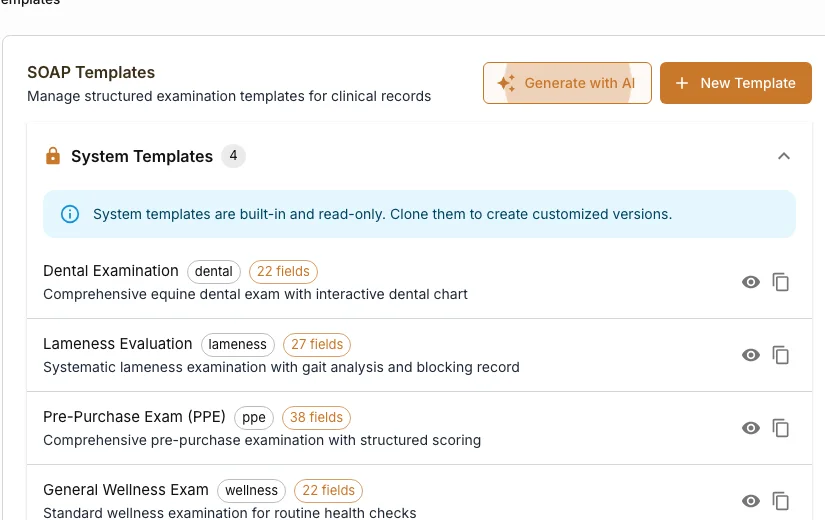
StableTrack includes a Dental Examination template as one of its four built-in exam templates. You pick it from the Template menu at the top of a new SOAP note, and the note becomes a guided dental form with an interactive dental chart, so an abnormality is marked on the tooth it belongs to.
A few details that matter in practice:
- The template does not lock the note. Any field can be skipped or extended with free text, and dictation works inside the template fields.
- You can change it. The built-in templates are read-only, but Clone to my templates gives you an editable copy. If your practice already has a dental form it likes, Generate with AI will build a template from an uploaded PDF, photo or Word file, and you edit the fields before saving.
- The note stays with the horse. It sits under SOAP Notes on the horse's record with every other visit, so last year's chart is one tab away from this year's.
- The next visit gets a date. A recall reminder on the horse's record takes a title, a due date and a type, so "Dental float, six months" is a dated task and not a memory.
For sedation, the dose is recorded with the visit, and controlled substances that are set up with a DEA schedule in Inventory are tracked by lot in the DEA logbook. More on how the notes themselves are written is on the equine SOAP notes page, and on how the record is organised on the equine medical records page.
One boundary to be clear about: the chart is a record of your findings. It does not interpret them, grade them for you, or suggest treatment.
FAQ
What is the Triadan system for horses? It is a three-digit tooth numbering system. The first digit is the quadrant (1 upper right, 2 upper left, 3 lower left, 4 lower right) and the last two digits are the tooth's position from the midline, from 01 for the central incisor to 11 for the last molar.
Which tooth is 106 on a horse? 106 is the upper right second premolar, the first cheek tooth on that side. The wolf tooth in front of it, when present, is 105.
How many teeth does an adult horse have? Between 36 and 44. The range comes from canines, which most mares lack, and wolf teeth, which vary from horse to horse.
How often should an equine dental chart be updated? At every oral exam. A chart is only useful for comparison if each visit records findings by tooth number, including the teeth where nothing was done.
Does StableTrack have an equine dental chart? Yes. The built-in Dental Examination template adds an interactive dental chart to the SOAP note. To see it on a horse from your own caseload, book a walkthrough.