An equine PMS (practice management system) with AI transcription capabilities converts your spoken words into narrative text, but equine examinations require structured data outputs that map directly to specific clinical fields. Generic AI scribe tools produce paragraph-style documentation that still requires manual reformatting into standardized formats like Triadan tooth numbering, AAEP lameness grades, and pre-purchase examination certificate fields. True AI templating for equine practice management goes beyond voice-to-text to understand the clinical context and populate the correct structured fields automatically.
What is the difference between AI scribe and AI template technology for equine veterinarians?
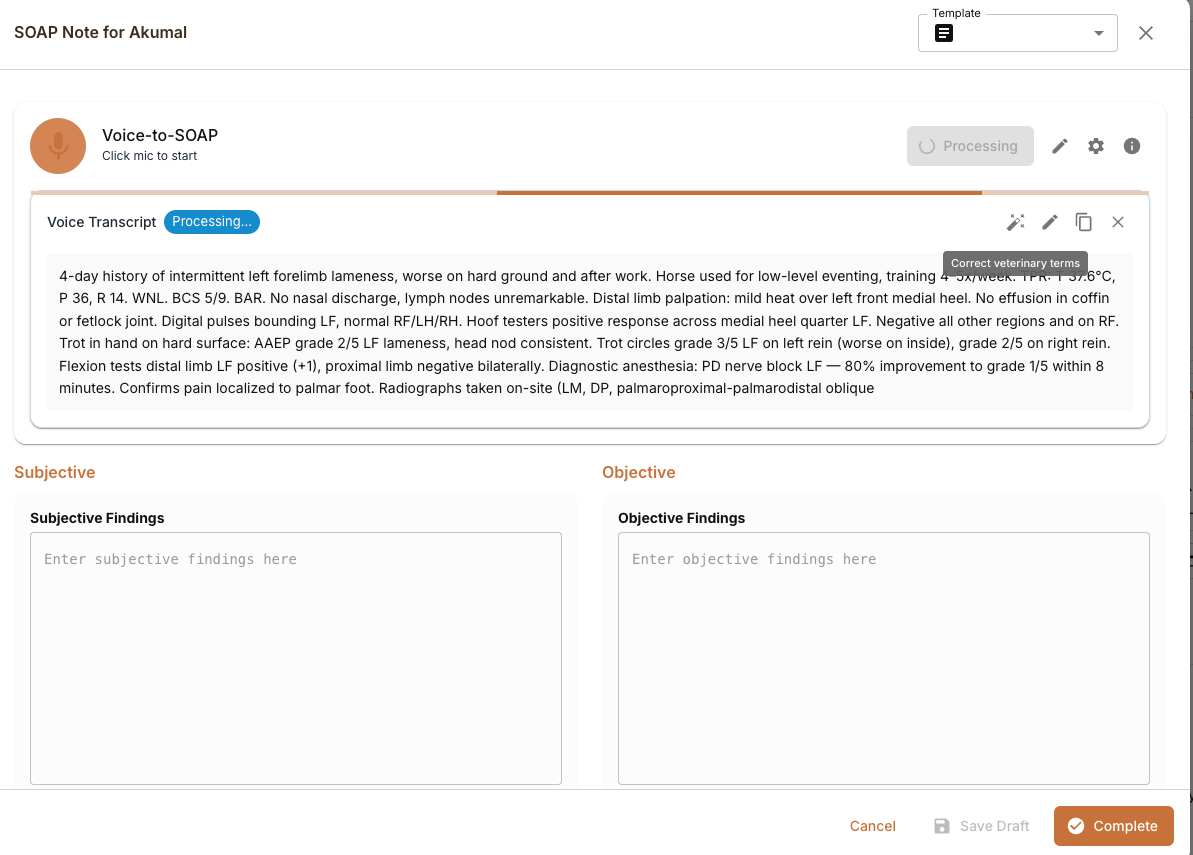
AI scribe technology converts spoken words into written narrative text, while AI template technology maps spoken clinical findings directly to structured examination fields like AAEP lameness grades, Triadan dental numbering, and pre-purchase examination certificates. When you dictate "The horse shows grade two lameness in the left forelimb with positive response to flexion testing," a scribe tool produces exactly that sentence in paragraph form, whereas an AI template recognizes the lameness grade, affected limb, and test result as separate data points and populates three distinct structured fields.
For general practice notes, narrative text might suffice. For equine examinations that require standardized reporting formats, particularly pre-purchase examinations and insurance documentation, structured field mapping becomes essential. A pre-purchase examination certificate cannot be completed with paragraph text alone. It requires specific sections for conformation assessment, flexion test results, radiographic findings, and risk categorization.
The distinction becomes clear when you consider that equine veterinary records need to integrate with industry-standard forms, insurance documentation, and referral templates that expect data in specific formats. Triadan tooth numbering and AAEP lameness grades built into equine medical records software understand this requirement. Generic scribes do not.
How do generic AI scribes handle equine clinical terminology?
Generic AI transcription services were trained on general medical terminology with limited exposure to veterinary-specific language, and they struggle significantly with equine anatomical terms, procedure names, and clinical scales that are standard in horse practice. A generic scribe might transcribe "Triadan two-oh-six" as "try a dawn 206" or miss the clinical significance entirely, treating specialized terminology as generic text rather than recognizing it as a specific tooth identification that belongs in a dental chart field.
Equine-specific terms like "Henneke body condition score" (a 1-9 scale for equine body assessment), "dorsal metacarpal disease," or "palmar digital neurectomy" often get mangled or require extensive post-dictation editing. The AI lacks context for why these terms matter or where they belong in structured documentation.
Generic scribes also miss the hierarchical relationship between findings. When you dictate "mild effusion in the left carpal joint with associated lameness," they create two separate text blocks rather than linking the anatomical finding to the functional assessment. This requires veterinarians to manually reorganize the transcript before it becomes clinically coherent or insurance-compliant.
Equine-trained AI templates, by contrast, recognize specialized terminology and map it to the correct field automatically, eliminating the post-dictation editing burden.
Why do pre-purchase examinations require structured AI templates rather than narrative transcription?
Pre-purchase examinations follow standardized formats that buyers, sellers, and insurance companies expect, with specific sections for conformation assessment, flexion test results, radiographic findings, and risk categorization that cannot be completed from narrative text. A narrative transcript of a PPE dictation creates a wall of text that still needs manual sorting into certificate sections, forcing veterinarians to reformat and reorganize the documentation before it can be submitted.
Structured AI templates recognize when you dictate "positive flexion response left fore" and populate the flexion test grid automatically, understanding that "grade one heart murmur" belongs in the cardiovascular section, not mixed into general observations. They synthesize multiple findings into buyer-focused language for risk assessment summaries, something generic scribes cannot do.
Pre-purchase examination certificate fields from insurance companies and financing institutions require PPE data in standardized formats for processing and underwriting decisions. Narrative text from generic scribes creates additional administrative burden that structured templates eliminate entirely. A veterinarian using an equine-specific AI template system can deliver insurance-ready PPE documentation without post-dictation reformatting.
What makes equine lameness documentation different from narrative notes?
Equine lameness examinations follow the AAEP (American Association of Equine Practitioners) grading system with specific scales ranging from 0-5, diagnostic procedures, and anatomical mapping requirements that cannot be captured in narrative form. Documentation needs to capture not just observations but standardized measurements that support diagnostic conclusions and integrate with specialist referral communications.
Narrative AI scribes record your spoken assessment as continuous text. When you dictate a comprehensive lameness evaluation, the output resembles conversational notes rather than systematic examination data. Structured AI templates understand that "grade two out of five right fore, worse on hard surface" contains multiple data points: lameness severity (scale position 2/5), affected limb (anatomical location: right forelimb), and environmental factor (surface type: hard ground). Each element populates the correct template field automatically.
Lameness examinations often involve before-and-after comparisons following diagnostic blocks or therapeutic interventions. Structured templates can track these changes systematically across examination episodes, while narrative notes require manual organization to maintain clarity and comparability. Veterinary records management for horses needs referral communications to equine specialists in formats that support additional diagnostic planning, imaging orders, treatment plans, and follow-up scheduling. These are capabilities that structured documentation provides and narrative text cannot.
How does voice-to-template mapping work in field conditions without internet connectivity?
Field veterinarians often work with limited connectivity, requiring AI systems that process voice input locally rather than through cloud-based transcription services that demand constant internet connection. Structured AI templates can cache common terminology and field relationships locally on the device, allowing voice-to-field mapping to continue working even when cellular service drops during farm calls.
Generic AI scribes typically require constant internet connectivity for processing. When connection fails, dictation either stops working or creates gaps in documentation that interrupt workflow and force veterinarians to complete handwritten notes or wait until connectivity returns. Local processing also addresses privacy concerns with clinical data. Voice recordings stay on the device rather than transmitting to external servers during processing.
Battery efficiency becomes important during long field days. Local AI template processing typically consumes less power than streaming audio for cloud transcription, extending device usability between charges. When connectivity returns, the system automatically syncs completed examinations without requiring manual upload or resynchronization steps.
This offline-first architecture is particularly important for rural equine practices where cellular coverage is inconsistent or unavailable. For a deeper look at how voice capture handles a real day in the field, see how voice-to-SOAP actually works on a 12-horse barn call.
See it in action
If you want to compare structured AI templates against your current documentation system, book a 15-minute walkthrough and we will work through a typical equine examination side by side.