Practice management leadership for equine vets in 2026.
It's a Tuesday in early spring. You're halfway through a four-barn day. The truck just pulled away from a pre-purchase exam that ran 45 minutes long because the buyer's agent wanted to talk through every finding. Your tech is texting that the 2pm colic is now a 1pm. The owner from this morning's lameness work-up has emailed twice asking when she'll get the discharge. And your associate just messaged the group chat: a client at her barn is asking why your practice doesn't have "that AI app the small animal place down the road uses."
So what can you take from this? AI is no longer something that might arrive "one day." It is already in your clients' pockets, in your practice management system's roadmap, and in the inboxes of your over-stretched team. This article is written for equine veterinary leaders who want to make AI work for their practice, rather than let it take over. It covers what AI can realistically do for equine vets today, how it can support staffing and reduce burnout, the most common misconceptions to watch out for, and a practical framework to start building your own practice AI policy. The aim is that you can take this article to your next partners' or management meeting and walk out with an agreed first draft of "how we do AI here."
Why AI is now a leadership issue, not an IT project
It is well recognized that equine vets carry a higher risk of stress, depression, and burnout than the wider veterinary population, and the wider population beyond that. Long hours, hard miles, emotional labor, and an administrative burden that doesn't end when the truck pulls back into the yard are repeatedly named as the key contributors. The 2025 AAEP wellbeing data showed equine practitioners scoring their own software satisfaction at 2.7 out of 5, with 84% saying they were actively considering switching. In other words, the "admin avalanche" is not just an irritation. It is part of the risk landscape for your team's health and your practice's retention.
At the same time, your clients are living in an on-demand world. Owners check symptoms with chatbots, get instant replies from telehealth apps for their own GP, and increasingly assume "AI" is part of any modern professional service. They will quietly question why a practice they are paying $1,200 a month for doesn't offer the same kind of polished digital communication they get from their accountant.
AI-enabled tools are also reaching equine vets directly. Voice-to-text documentation, automated discharge summary drafts, intelligent scheduling, route optimization for barn calls, image triage in radiology, AI-assisted lameness scoring research. All of these are no longer hypothetical. They are showing up in PMS roadmaps, in journals, and in the conversation at AAEP every December. At the 2025 conference, 67% of surveyed equine vets named voice-to-text SOAP notes as the single feature they most wanted from their software.
Ignoring AI doesn't make it go away. It simply moves decisions about its use outside the practice, into the hands of clients, vendors, and individual staff members who will adopt the tools they need without practice oversight. A tech using a free transcription app on her personal phone to dictate notes about your patients is an AI decision. A vet pasting a clinical query into a public AI tool is an AI decision. A new graduate using AI to summarize a paper for case rounds is an AI decision. These are all happening already, in every practice, without policy.
Professional and regulatory bodies are starting to consider AI "in the round": how it affects transparency, consent, data governance, accountability, and clinical responsibility. Reviews in veterinary imaging, in equine documentation, and in PMS feature sets are expanding rapidly. The leadership question is not whether AI is coming into your practice. It is how you want it to behave when it gets there.
What AI can realistically do for an equine practice today
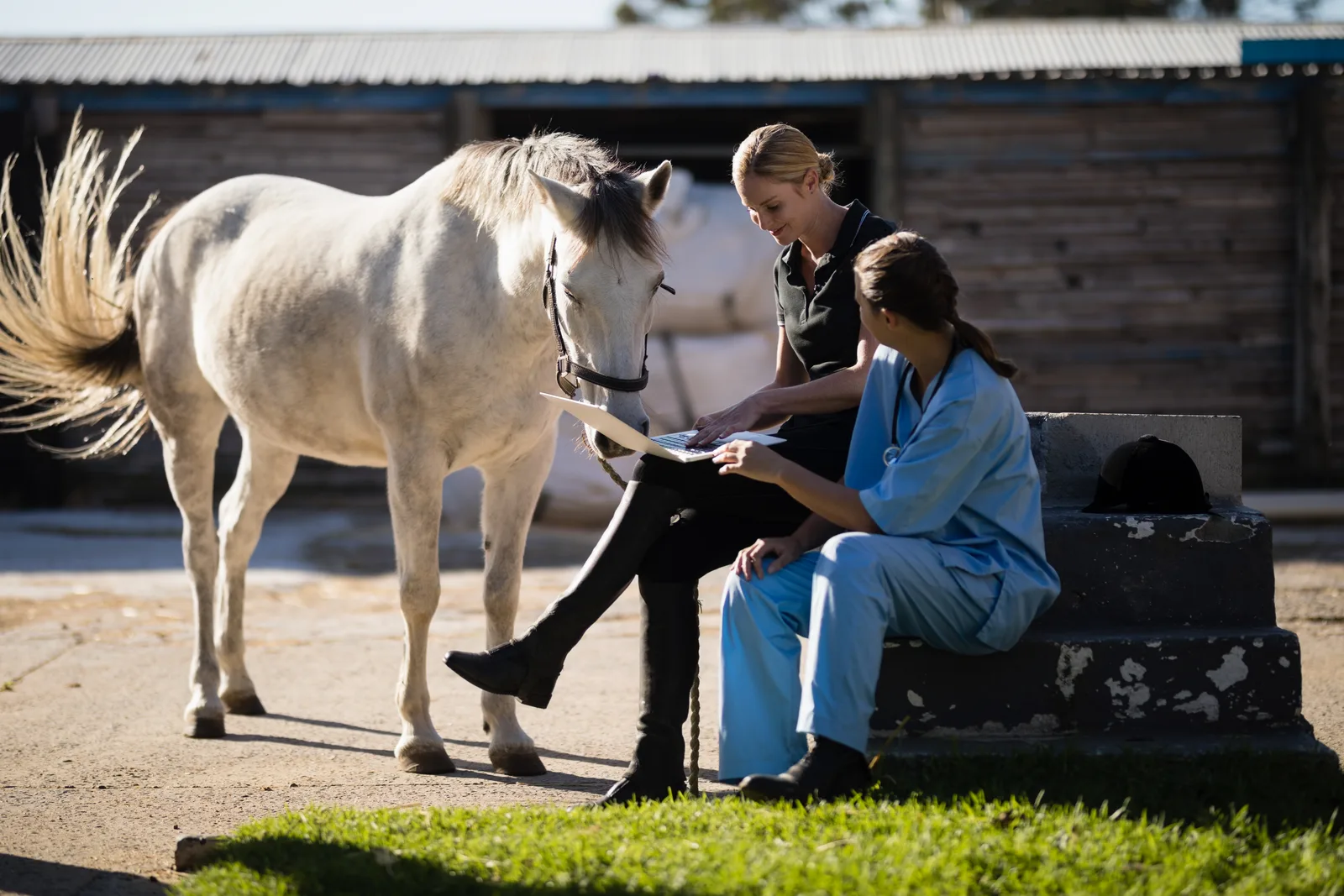
The hype around AI is loud. The realistic picture is narrower, more useful, and more boring than the marketing suggests. Broadly, current AI in equine practice falls into four buckets.
1. Administration and workflow
This is the biggest, most immediate win, and the one with the lowest clinical risk. Tasks that AI can genuinely help with today include:
- Voice-to-text SOAP note drafting, with equine terminology recognized correctly (fetlock vs cannon, AAEP lameness grade 2, Henneke BCS, Reef cardiac scale).
- Discharge summary drafting from existing clinical records since the last visit.
- Natural-language invoice creation: "invoice for today's barn call, three spring vaccines at $45 each."
- Intelligent appointment booking based on a voice command.
- Drafting routine client emails: vaccination reminders, post-procedure aftercare, balance-due nudges.
- Summarizing a horse's record before you walk into the next stall.
The honest measurement on this category is hours per week back. Published research on AI documentation shows variable savings — roughly 10% system-wide in a five-hospital JAMA study, and 20 to 30% in focused studies. For many practices that's evenings not spent writing up notes at the kitchen table. For a closer look at how this plays out across a real day, see how voice-to-SOAP actually works on a 12-horse barn call.
2. Clinical decision support
This is the category that creates the most anxiety, and the one where the line needs to be drawn most clearly. AI in 2026 can:
- Suggest differential diagnoses for review (research and study tools, not in-PMS).
- Flag possible drug interactions or dose ranges.
- Read radiographs and ultrasounds for triage support (still primarily a small-animal capability, growing in equine).
- Surface relevant prior history from a long patient record before you read it.
What it cannot, and should not, do is make the clinical decision. The right framing for your team: AI structures what you say. It does not decide what to do. Every AI-drafted note, summary, or suggestion is a starting point for a vet to review and edit. If a tool offers more than that, it is a tool to be wary of, not adopted faster.
3. Client communication and experience
AI is genuinely good at the writing tasks vets routinely deprioritize:
- "Dumbing down" technical discharge instructions into plain-language owner versions.
- Drafting reminder sequences for vaccinations, dental floats, and Coggins testing.
- Generating consistent post-visit summaries that owners actually read.
- Translating clinical updates into language that fits the relationship (a Thoroughbred owner in Lexington and a backyard rider in rural Idaho do not need the same email).
The benefit here is not just speed. It's consistency. New graduate vets, locums, and front-desk staff can produce client-facing communication that sounds like your practice, not like four different people had a go at it.
4. Practice intelligence
_1771348673727.png)
The least mature category, but the most strategically interesting:
- Identifying horses overdue for routine work.
- Surfacing patterns in clinic revenue (which procedures, which vets, which seasons).
- Forecasting cash flow from open invoices and historical patterns.
- Highlighting clients at risk of churn before you lose them.
Most equine practices have this data already. They just can't see it. AI is increasingly the layer that turns a database into a dashboard.
The most common misconceptions
These come up in every partner meeting where AI is discussed for the first time. They are worth naming directly.
"AI is going to replace vets." No serious vendor or regulator believes this is happening to clinical decision-making in equine practice in any meaningful timeline. What AI is replacing is the paperwork around clinical decision-making. The vet still makes the call.
"AI will get the equine terminology wrong." First-generation tools did. Modern equine-trained models handle the specific vocabulary: hands, breeds, anatomy, lameness scales, Coggins, PPE structures, hoof care terms. The right question to ask a vendor is not "does it do voice-to-text," it is "what did it train on."
"It's another expensive add-on." Some tools are. Many are now built into the PMS at no extra per-call cost, or metered transparently so usage is visible. The honest comparison is not "AI vs no AI." It is "AI cost vs the cost of unbilled procedures, vet burnout, and clients leaving because communication is patchy."
"My data will go somewhere I don't control." This is the right concern, and the wrong question. The right question is which AI, with which data residency, under which contract. Anything that can't answer those three questions clearly is not ready for your practice.
"It will create more work, not less." This is true if AI is rolled out without a policy, training, or scope. It is also true of every PMS that ever shipped without onboarding. The work is in the rollout, not in the technology.
"My team will use it badly." Possibly, if no one has told them what good use looks like. This is exactly why you need a written practice policy, not a verbal "use your judgment."
The benefits that compound
When AI is rolled out with intent, the benefits stack:
- Staff wellbeing. Documentation hours back. Less weekend catch-up. Fewer notes finished at 10pm. This is the single biggest retention lever a practice has in 2026.
- Clinical consistency. Every horse gets a properly structured note, not the one the vet had energy for at the end of a long day.
- Client experience. Faster turnaround on discharges, clearer language, fewer "did you get my email" follow-ups.
- Defensible records. Voice-dictated notes are more thorough than tired-fingers notes. Communication logs are complete. The audit trail holds up.
- Practice capacity. Two evenings of admin a week, across four vets, is the equivalent of half a full-time hire. Without hiring.
- Better data. Structured documentation feeds structured reporting feeds smarter decisions.
The compounding effect matters. None of these alone justifies a PMS migration. Together, they materially change how a practice runs.
A practical framework for a practice AI policy
The aim of a practice AI policy is not to write a 40-page document no one reads. It is to give your team a clear answer to four questions:
- What AI tools are we using on practice data?
- What can staff use them for?
- What can they not use them for?
- Who is responsible when something goes wrong?
A reasonable first-draft policy fits on two sides of a single page. It covers:
Scope
Which tools are sanctioned (PMS-embedded AI, approved transcription, approved communication drafting). Which tools are not (public AI tools with client or patient data, anything not vendor-vetted, anything that stores data outside your jurisdiction without contract).
Permitted uses
- Drafting SOAP notes from voice dictation, with vet review before saving.
- Drafting discharge summaries, with vet review before sending.
- Drafting routine client communication, with vet or practice manager review.
- Generating practice reports and dashboards.
Prohibited uses
- AI generating clinical decisions, diagnoses, or treatment plans without vet review.
- AI tools handling client or patient data without a signed data processing agreement.
- AI used to communicate with clients in a way that implies a human wrote it when one didn't.
- Personal AI tools (free apps on personal devices) used on practice data.
Consent and transparency
A short, plain-language statement on your client intake form: "We use AI tools to help us prepare records, summaries, and communications. A veterinarian reviews everything before it leaves the practice. Your data is handled under [data agreement reference]."
Accountability
The named partner or practice manager who owns the AI policy, reviews it quarterly, and signs off on new tools. This is non-negotiable. AI policy without an owner becomes shelf-ware in a month.
Review cadence
Quarterly. The space is moving fast enough that an annual review is too slow.
What to do next
Take this article to your next partners' or management meeting. Use the four-question framework above. Aim to leave the meeting with:
- A named AI policy owner.
- A list of currently-in-use AI tools (you'll be surprised what's already happening).
- A first draft of permitted and prohibited uses.
- A date for the policy v1 to be circulated to the team.
The practices that will pull ahead in 2026 are not the ones with the most AI features. They are the ones that decided, deliberately, how AI fits into the way they already work. The technology is the easy part. The leadership is the work.
---
StableTrack is the AI practice management platform built exclusively for equine veterinarians. AI features are designed around a strict scope boundary: AI structures the paperwork. The vet keeps the judgment. To see how that boundary plays out in practice, book a 15-minute walkthrough.
Part 2 of this series will cover practical AI implementation: choosing tools, rolling them out to the team, and measuring the impact on the practice.